Heat and Moisture Exchanger Filters
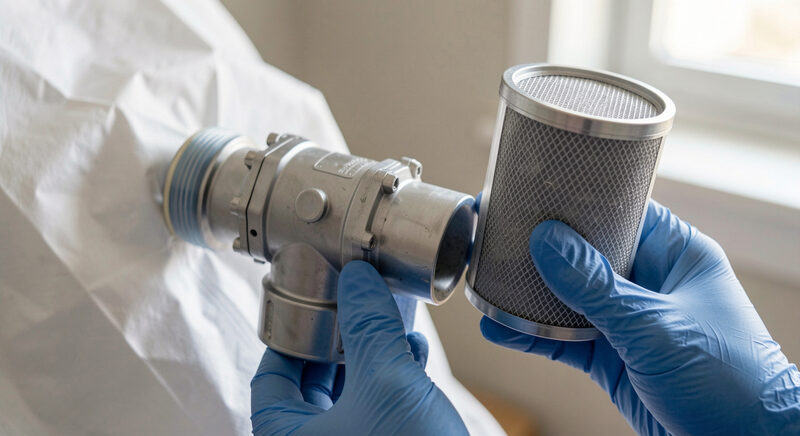
A heat and moisture exchanger, or HME, sits between the breathing circuit and the patient and recovers warmth and water from the gas the patient breathes out, returning them on the next breath. Because the same device often filters particles as well, it is commonly called an HME filter. It is passive: it needs no power, no water and no controls, which is why it is found on transport ventilators, in anaesthetic rooms and on many intensive care patients. This guide explains how it works, the types available and what changes its efficiency.
How does an HME recover heat and moisture?
Exhaled gas is warm and saturated with water vapour. As it passes through the HME on its way out, the device's medium takes up some of that heat and moisture. On the next inspiration, cooler drier gas passes back through the same medium and picks up what was stored. The device is, in effect, a small heat and moisture store that is refilled with every breath. The medium is chosen so that it holds water without letting it pass freely, which is why some HMEs use paper or foam treated with a hygroscopic salt such as calcium chloride.
What are the three types of HME?
HMEs fall into three broad groups. Hygroscopic devices use a material of low thermal conductivity that is impregnated with a hygroscopic chemical, so they hold water chemically as well as physically. Hydrophobic devices use a pleated medium that repels water and does not absorb it, and the same medium acts as a microbiological filter. Combined, or hygroscopic-hydrophobic, devices place the hygroscopic material on the patient side of a hydrophobic filter membrane, so they both humidify and filter. The choice between them affects moisture output, resistance to flow and how the device behaves when secretions reach it.
How does tidal volume change HME performance?
HME efficiency is not fixed. A study using a physical model of the respiratory system measured absolute humidity recovery across a range of settings and found that increasing tidal volume reduced the fraction of humidity recovered, while changing respiratory rate or inspiratory flow had less effect. In other words, an HME is most efficient at low tidal volumes and loses ground as each breath gets larger. This is the reason an HME suits gentle ventilation better than high volume ventilation, and why the patient's minute volume is part of deciding whether passive humidification is enough.
How much moisture does an HME return?
The answer varies widely by device. A 2025 modelling and measurement study in Scientific Reports tested a sample of HMEs and found performance ranging from about 5 to 30 milligrams per breath, with some devices above 80 percent efficiency across the test range and others below 20 percent at high water load. Small HMEs made for laryngectomized patients returned only 2 to 5 milligrams per breath because of their size. The practical point is that HMEs cannot be treated as interchangeable: two devices that look similar can differ several fold in how much moisture they return.
Why is an HME often also a filter?
Many HMEs include a filter layer, so the same device that returns moisture also removes particles. Manufacturers test this separately, and combination devices typically report a bacterial filtration efficiency above 99.99 percent for a mean particle size near 3 microns, with viral efficiency quoted at a similar level. The bacteria and viral filters guide explains how that filtration works and where filters are placed. On a combined device, the moisture medium usually sits on the patient side and the filter membrane behind it, so that the patient's own moisture is returned before the gas reaches the filter.
What are the limits of passive humidification?
Because HMEs recover rather than create moisture, they depend on the patient's own expired gas and on the settings in use. They are less effective at high tidal volumes, they add resistance and dead space to the circuit, and they can become blocked if secretions reach the medium. Where ventilation is prolonged, where secretions are thick, or where minute volume is high, active humidification with a heated chamber and circuit is usually preferred. The humidification guide compares the two approaches, and the ventilator breathing circuits guide explains the dead space that any device at the Y-piece adds.
How an HME is positioned and connected
An HME sits between the Y-piece and the airway, where it can act on both the inhaled and the exhaled gas. It has a machine side and a patient side, and the moisture medium is normally on the patient side so that the patient's own moisture is returned before the gas reaches the filter layer. Fitting it the wrong way round changes how it performs and can put the filter where the moisture should be. The connectors are the standard 22 mm and 15 mm cones, but the assembly around the HME, including any catheter mount or swivel, still has to be kept short and light. Because the device adds dead space at the airway, its size is matched to the patient, and a small HME is used for a small patient rather than an adult device on a paediatric circuit.
What to check when using an HME
Confirm the device is the right size for the patient and that its connectors match the circuit and the airway. Check that it is seated properly and not inverted, and that it is changed according to the manufacturer's instructions rather than left in place indefinitely. Watch for a rise in airway pressure or a change in secretions that could mean the medium is becoming blocked. When you change the device, note how much moisture it held and how the secretions looked, because those details tell you whether passive humidification is still keeping up or whether the patient would do better on active humidification.