Bubble CPAP in Neonatal Care
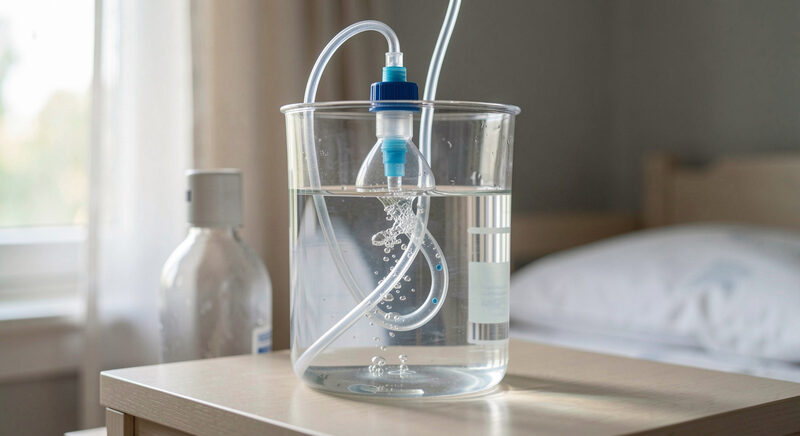
Bubble CPAP supports a spontaneously breathing newborn by holding a steady pressure in the airway, generated in the simplest possible way: the expiratory limb of the circuit is dipped into a column of water, and the depth of that water sets the pressure. It was introduced in the mid 1970s and is now widely used in neonatal units, especially where equipment is limited, because it needs no electricity to generate pressure, no compressed air in some designs, and only a gas source, a humidifier and a water chamber. This guide explains how it works and what to check at the cot side.
How does bubble CPAP generate pressure?
Gas flows into the circuit, is warmed and humidified, and is delivered to the infant through short nasal prongs or a mask. On expiration, the gas leaves through the expiratory limb, which is submerged in sterile water at a set depth. The pressure in the circuit equals the depth of submersion, so 5 centimetres of water gives about 5 centimetres of water pressure. As the gas escapes it bubbles through the water, and those bubbles create small pressure oscillations in the circuit. The oscillations are thought to help open small airways and recruit lung volume, which is one reason bubble CPAP is used rather than a simple flow of gas.
Why is the pressure set by a water column?
Setting pressure by depth is robust and visible. The clinician lowers or raises the expiratory tube in the water chamber to change the pressure, and the bubbling confirms that gas is flowing and that the system is not blocked. The usual range is around 4 to 10 centimetres of water, adjusted to the infant's condition and to the unit's protocol. Because the pressure depends on the water level, the chamber has to be watched: if it runs dry, the pressure falls and the support is lost, and if it is overfilled the pressure rises. The bubbling is not decoration; it is the visible sign that the therapy is being delivered.
What are the key checks at the cot side?
Confirm the system is bubbling on expiration, since a system that has stopped bubbling may have a leak, a blocked prong or an empty chamber. Check the depth of the expiratory limb against the prescribed pressure and top up the water chamber as needed. Check the humidifier is set, commonly around 37 degrees Celsius, so the gas reaches the infant fully saturated and does not dry the mucosa. Look at the prongs or mask for correct size and position, and at the nasal septum for signs of pressure damage. The CPAP and BiPAP masks guide covers interface fit in more detail, and the humidification guide explains why conditioned gas matters for the airway.
How is the interface managed?
The nasal interface is the part the infant feels most. Prongs that are too large distend the nostrils, and prongs that press on the septum can cause injury over hours. Many units alternate between prongs and a mask, for example every four hours, to give the skin and septum a rest and to reduce the risk of pressure areas around the nose. The interface is secured with a cap and straps that hold it without pulling, and the position is checked at every set of observations. A stable interface that does not leak is what allows the set pressure to reach the airway.
Why does the infant need a gastric tube?
Positive pressure delivered to the nose can also push gas into the stomach, which distends the abdomen and can splint the diaphragm, making breathing harder. A nasogastric or orogastric tube is therefore placed to let that gas escape, and it also allows feeding when the infant is stable enough. The tube is part of the bubble CPAP setup, not an unrelated device, and its position and patency are checked with the rest of the system. An infant with a distended abdomen on CPAP is a sign that gastric decompression needs attention.
What else does the circuit need?
Because bubble CPAP has no audible alarm to announce a leak, the circuit has to be inspected rather than trusted. Staff check the bubbling, the water level, the prong position and the abdominal girth at intervals, and two clinicians often check the whole system at handover. The gas source, the humidifier, the chamber and the prongs form one assembly, and a fault anywhere in it shows up as a change in the bubbling or in the infant's work of breathing. The ventilator breathing circuits guide describes the same habit of reading a circuit as a whole.
What to do when the bubbling stops
Because bubble CPAP has no alarm for a leak, a circuit that stops bubbling is found by looking, not by listening for a warning. The first check is the water chamber: if it has run low, the expiratory limb is no longer submerged and the pressure is lost. If the chamber is full, the cause may be a leak at the prongs, a disconnected limb, a blocked prong or a gas supply problem. The infant is assessed at the same time, because a change in bubbling often comes with a change in the work of breathing. The system is restored methodically, water topped up, connections checked, prongs reseated, and the bubbling confirmed before the clinician moves on. Treating a quiet circuit as a signal, rather than as a normal state, is what keeps this simple therapy reliable.
What to do at handover
Walk the setup from the gas source to the infant. Confirm the prescribed pressure and the water depth, that the system is bubbling, that the humidifier is at its set temperature and the chamber has water. Check the prong or mask size and the septum, and confirm the gastric tube is patent and the abdomen is soft. Then note anything that changed during the shift, such as a rising oxygen requirement or a change in the bubbling. That short walk, done at every handover, is what keeps a simple and effective therapy from failing quietly.