Airway and Oxygen Delivery
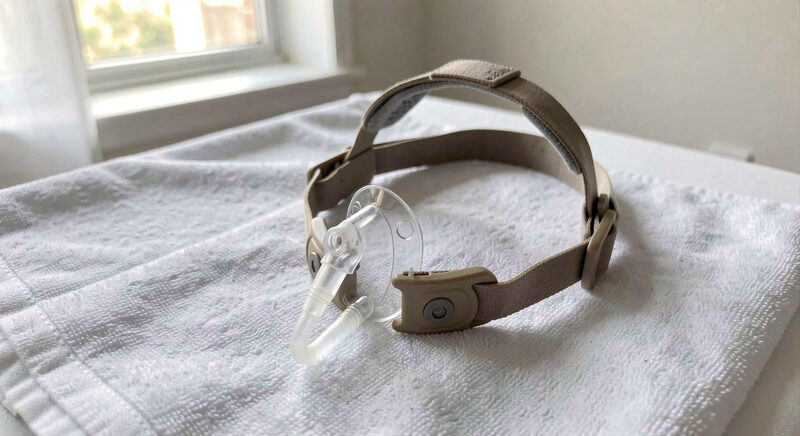
The devices that reach the patient's airway are the last link in the chain that starts at the ventilator or the oxygen supply. A mask, a set of nasal prongs, a nebulizer chamber or a catheter mount decides how gas and drugs actually arrive, and how comfortable the patient is while they do. This section gathers the guides on CPAP and BiPAP interfaces, bubble CPAP in neonates, nebulizer kits and catheter mounts, and on the checks that keep each one working.
What is the difference between CPAP, BiPAP and NIV?
Continuous positive airway pressure, or CPAP, holds a steady pressure in the airway throughout the breath, which helps keep small airways and alveoli open. Bilevel positive airway pressure, or BiPAP, alternates between a higher pressure on inspiration and a lower pressure on expiration, so it supports the work of breathing as well as holding the airway open. Non-invasive ventilation, or NIV, is the broader term for supporting breathing through a mask or interface rather than a tube. All three rely on a well fitting interface, because pressure that leaks around the mask does not reach the airway. The CPAP, BiPAP and NIV masks guide covers how interfaces differ and how fit is judged.
How is CPAP delivered to a newborn?
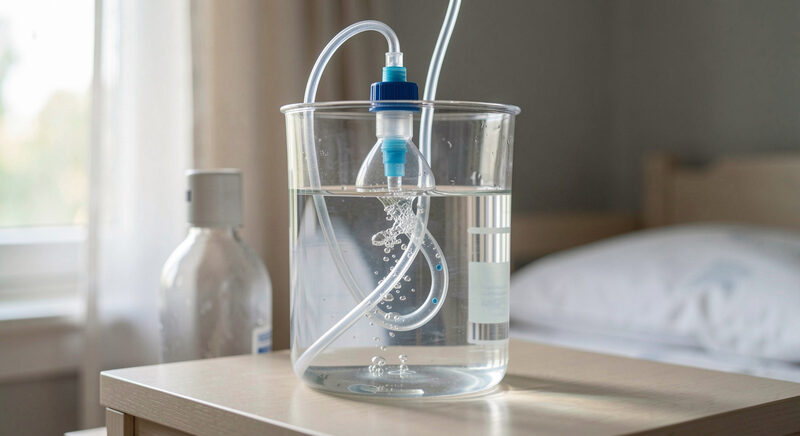
In neonates, CPAP is often delivered by a continuous flow system in which the expiratory limb is submerged in a water column, so the depth of that column sets the pressure. This is bubble CPAP, and the bubbling itself produces small pressure oscillations that help keep the lung open. It is used for preterm infants with respiratory distress and as a step after extubation, and it needs only a gas source, a humidifier, a water chamber and short nasal prongs. Because the pressure is set by the depth of the expiratory limb in the water, the system is visible and easy to adjust, but it also has to be watched, since a chamber that runs low or a circuit that stops bubbling removes the support without any alarm. The bubble CPAP guide explains how the pressure is set and why the circuit must keep bubbling.
How do nebulizer kits deliver drugs into a circuit?
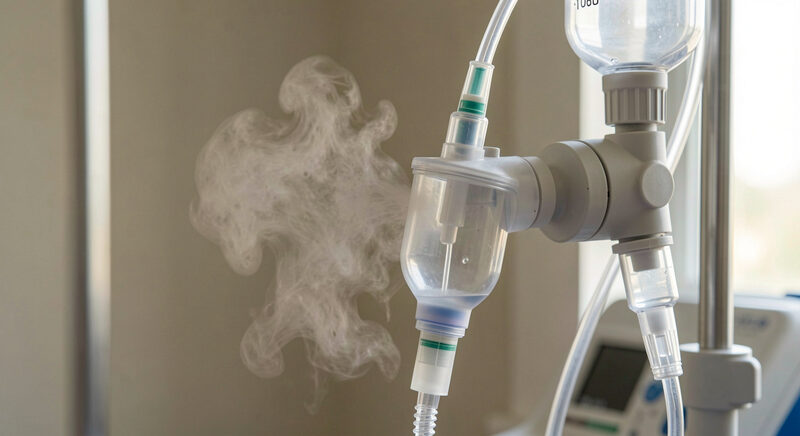
A nebulizer turns a liquid drug into an aerosol that the patient inhales. During mechanical ventilation, the nebulizer is placed in the circuit and the drug has to survive the tubing, the humidifier and the airway to reach the lung. Three technologies are used: jet nebulizers, which use a gas flow to break up the liquid; ultrasonic nebulizers, which use a vibrating crystal; and vibrating mesh nebulizers, which push the liquid through a fine mesh. Where the nebulizer sits in the circuit, and how much bias flow the ventilator provides, change how much drug reaches the patient. The nebulizer kits guide sets out the placement and the evidence behind it.
What does a catheter mount do?
A catheter mount is the short flexible link between the breathing circuit and the airway device. It absorbs the movement of the circuit so that it does not pull on the tube, and it provides a place to connect suction or a sampling line. A double swivel elbow lets the assembly rotate in two planes, which reduces the torque on the airway. The catheter mounts and closed suction guide explains how the assembly is kept light and how closed suction works without disconnecting the patient from the ventilator.
What do these interfaces have in common?
Every interface adds dead space and resistance, and every one depends on a good seal or a good position to work. A mask that leaks wastes pressure, a set of prongs that is the wrong size irritates the nose, and a catheter mount that is too long adds volume the patient rebreathes. The ventilator breathing circuits guide explains why those added volumes matter more in small patients. The practical approach is the same across all of them: choose the size that fits, keep the assembly as short and light as the clinical need allows, and check the interface as carefully as the machine. An interface that is uncomfortable or that leaks is not a minor inconvenience; it is the most common reason non-invasive support fails and the patient has to be intubated.
Oxygen delivery interfaces beyond pressure support
Not every patient needs pressure support. A range of simpler interfaces delivers oxygen at a set concentration: nasal cannulae for low flows, simple face masks, venturi masks that entrain air to give a fixed fraction of inspired oxygen, and reservoir masks for higher concentrations. High flow nasal therapy sits between these and CPAP, delivering heated humidified gas at a set flow and oxygen concentration through soft nasal prongs. Each interface has a flow range and a concentration range, and choosing one means matching both to the patient's need. Because these devices also dry the airway at higher flows, humidification is part of using them well, as the humidification guide explains.
Where to start in this section
If you work with adults on non-invasive support, start with the CPAP and BiPAP masks guide. If you work in neonatology, the bubble CPAP guide is the one that covers the cot side checks. If your interest is drug delivery during ventilation, the nebulizer kits guide compares the technologies and their placement. And if you handle intubated patients day to day, the catheter mounts guide covers the link that keeps the circuit off the tube.
Airway and Oxygen Delivery
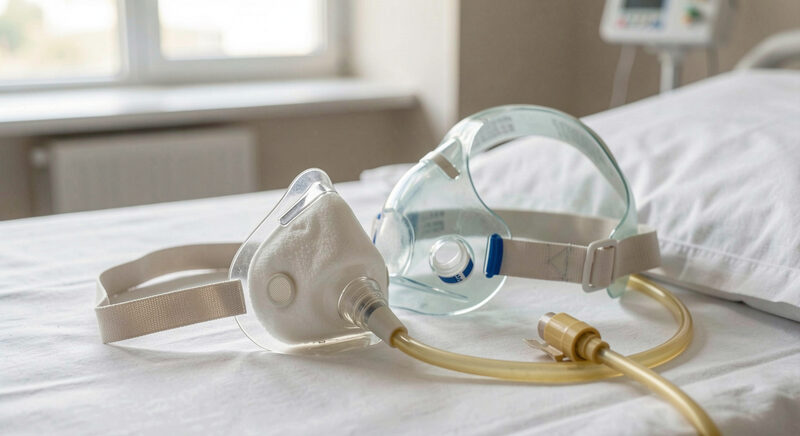
CPAP, BiPAP and NIV Masks
How CPAP, BiPAP and NIV interfaces differ, what mask fit and leak mean for therapy, and how to judge an interface at the bedside.
Seal, leak and skin: how an interface is judged.
Airway and Oxygen Delivery
Bubble CPAP in Neonatal Care
How bubble CPAP generates pressure through a water column, why the circuit must keep bubbling, and how humidification and prongs are managed.
Pressure from a water column, and the checks it needs.
Airway and Oxygen Delivery
Nebulizer Kits and Aerosol Delivery
Jet, ultrasonic and vibrating mesh nebulizers, where to place a nebulizer in the circuit, and how bias flow and humidity change drug delivery.
Placement and bias flow decide the dose.
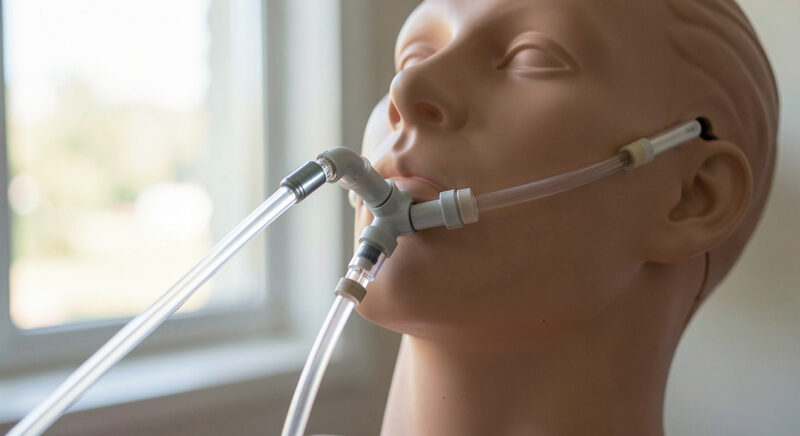
Airway and Oxygen Delivery
Catheter Mounts and Closed Suction
What a catheter mount does between the circuit and the airway, how closed suction systems work, and how to keep the assembly light and swivel-free.
Keep the circuit off the tube and suction in a sleeve.