Water Traps in Breathing Circuits
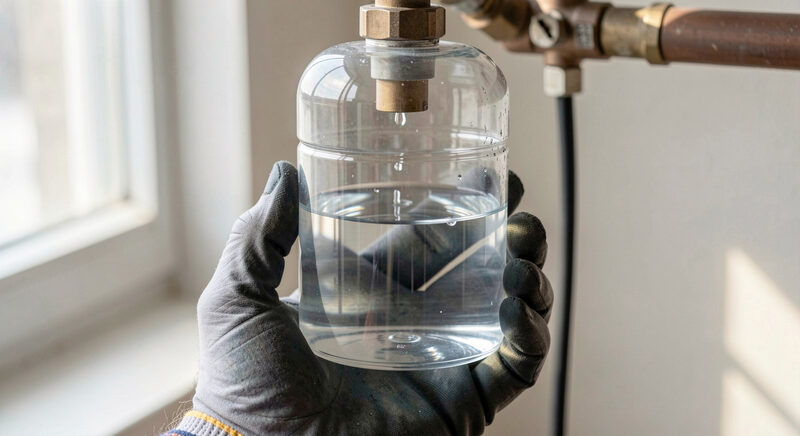
Warm humidified gas cools as it moves down a breathing circuit, and the water it can no longer hold condenses on the tube wall and runs downhill. A water trap is the small chamber that gives that liquid somewhere to collect, so it does not pool into a dependent loop, gurgle, raise resistance or move towards the patient. This guide explains what traps collect, how single and double traps differ, and how to empty and check them without breaking the circuit.
What does a water trap actually collect?
The liquid in a trap is condensate, not spillage. It forms because the gas leaving a heated humidifier carries more water vapour than the cooler tubing can hold. As the gas loses heat to the room, the excess vapour turns back into water on the inside of the limb. The trap sits at a low point where gravity sends that water. Some circuits have a trap on one limb only, usually the expiratory side where gas is coolest, while others place traps on both limbs and at the Y-piece to catch condensate wherever it settles.
Why is condensate more than a nuisance?
A small amount of water in a limb is normal, but it is not harmless. Water that collects into a plug can narrow the tube, adding resistance the ventilator has to overcome and changing the delivered volume. If the limb is lifted or the patient moves, a bolus of condensate can be tipped towards the airway. Review work on ventilator circuits and humidification notes that condensate in the circuit is treated as contaminated and is not returned to the humidifier. The reason to manage traps carefully is that the liquid is both a mechanical and an infection control concern, not simply an untidy detail.
How do single and double water traps differ?
A single trap is one chamber with a drain, placed at the lowest point of a limb. A double trap provides two chambers, so condensate can be emptied from one while the other keeps the circuit closed. The double design is common where the circuit must stay sealed, for example during ventilation where breaking the loop to empty a full trap would lose pressure and expose the patient to unfiltered gas. The extra chamber also gives more capacity between empties, which matters at high minute volumes where condensate forms faster.
How are traps emptied without breaking the circuit?
The usual method keeps the patient side closed. The trap is held upright, the drain cap is opened over a waste container and the liquid is allowed to run out, then the cap is closed firmly before the trap is returned to its hanging position. The trap is never inverted towards the patient and never overfilled. On a heated wire circuit, this is done at the same time as the temperature and water level checks described in the heated wire circuits guide, because both are part of the same humidification routine.
How often should a trap be checked?
There is no single interval that fits every patient, because condensate forms faster at higher minute volumes and in cooler rooms. The practical approach is to check the trap at every set of observations and whenever the circuit is touched, and to empty it when it is noticeably full rather than waiting for a gurgle. A bench study of heated wire humidifiers found that condensate increased with both minute volume and respiratory frequency, reaching around 9.4 grams over seven hours at the higher settings, so a patient ventilated at high settings in a cold room needs more frequent checks than one on gentle settings.
What else in the assembly collects water?
Traps are not the only low points. The dependent loop of a limb, the expiratory valve housing on some circuits, and the space in a filter or heat and moisture exchanger can all gather liquid. When condensate keeps reappearing in the same place, the cause is usually a low point that was not supported or a circuit hung so that water runs to one spot. Supporting the limbs so that they slope towards a trap, and avoiding unnecessary loops, is often enough to move the water where it can be managed. The HME filters guide explains how a passive exchanger handles moisture differently from a heated circuit.
How traps connect to the circuit
A water trap attaches to the limb at a point the manufacturer intends, usually by a port built into the tubing or by a connector between two lengths. The trap hangs below that point so gravity fills it, and its cap faces down or to the side so it can be drained without lifting the circuit. Traps are not interchangeable between circuits: the connector has to match the limb, and a trap fitted to the wrong port can leak or fail to collect. When a trap is replaced, the circuit is kept closed, the new trap is seated fully, and the level is noted. Because the trap is the lowest point of the limb, its position is chosen rather than left to chance, and the tubing is supported so that condensate runs towards it rather than away.
What to do at the next circuit check
Add the trap to the routine you already follow. Look at the whole circuit from machine to patient, identify the lowest point of each limb, and confirm a trap is sitting there. Check the trap level, empty it if needed and close it firmly. If water keeps returning in the same place, change how the limb is supported so it drains towards the trap instead of pooling. Recording the amount and where it collected gives the next clinician a clue about how the humidification is behaving, and it turns a recurring gurgle into a fixable problem.